How to use an electric car: A practical guide to driving, range, and charging

Curious about how to properly use an electric car from driving and range to charging? This practical guide clearly explains the basics of EV operation, how to maximize driving range, and the different ways to charge the battery. Whether you’re borrowing an EV via carsharing or considering your own, after reading this article you’ll know exactly how to drive and charge an electric car.
Electric vehicles are currently a complement to the fleet at Autonapul, but their number will increase in the coming years just like the share of EVs across the Czech Republic. Be ready for the shift to electromobility and learn why you don’t need to be afraid of driving an electric car.
The basics of using an electric car
Basic EV driving is just like a regular car with an automatic transmission. An EV, like an automatic, has two pedals: an accelerator and a brake. When you start or “turn on” the vehicle, you won’t hear anything, only a message on the dashboard (usually “Ready”) indicates the car is ready to move. Simply shift the gear lever or control to D for drive or R for reverse. Once you release the brake, the car will slowly start moving in the chosen direction. Just like a regular automatic.
Be extra cautious of your surroundings. Pedestrians and cyclists may not hear you starting to move, especially when reversing, this can be dangerous. EVs emit a low-speed alert sound up to 30 km/h to warn pedestrians, but it’s still your responsibility to stay aware.
Driving an electric car
One major advantage of EVs over conventional cars is energy recuperation. But it’s not 100% efficient. Smooth driving is crucial. See a red light ahead? Just lift your foot off the accelerator, and the car will start slowing down while recovering energy into the battery. For stronger deceleration, use the brake pedal.
Initially, the EV brakes using the electric motor. Only during harder braking do friction brakes engage. EVs are perfect for urban driving. They emit no exhaust gases and produce less brake dust due to regenerative braking. However, when driving outside the city, you need to keep in mind some differences from combustion engine cars.
Range
Combustion engines are inherently inefficient. EVs are the opposite. You’ll notice energy consumption is more affected by aerodynamic drag at higher speeds, AC use, snow, and heating. No need to freeze, but don’t overheat the cabin unnecessarily. Same with speed: driving 110 km/h instead of 100 km/h may save a few minutes, but significantly increases energy usage. The displayed range continuously updates based on your driving style and is fairly reliable. A hilly route reduces range similarly to flat driving - assuming you maximize regeneration downhill.
Most EVs also have an ECO mode, which usually limits acceleration, top speed, and climate control. In winter, remember: battery energy is stored chemically. Driving warms the battery, but if it cools down overnight, the car may not access all stored energy. If you park with 40 km of range, a cold battery might show just 5 km in the morning. This isn’t an issue with a more charged batter, it will warm up while driving. But if the battery is nearly empty, it might not have enough energy to warm itself up. A safe minimum charge is around 20-25%.
Charging an electric car
Charging an EV requires a different mindset than refueling. Ideally, charge the car whenever it’s parked and charging is possible. That’s why Autonapul cars are picked up and returned at charging stations. You wouldn’t go to a gas station to top up a quarter tank, but with EVs, it makes sense.
Going to a meeting? Shopping? Staying overnight? Always check for charging options. Ideally, keep charging between 20-80%. During charging, the connector is locked in the car and must be unlocked (via a button in the car or on the key) to remove it. Charging uses either AC (alternating current) or DC (direct current).
Tech Corner: Power from the grid is AC. Most EVs run on AC, but batteries store DC. So we need to convert AC to DC. When charging with AC, the car’s onboard charger handles the conversion, its power is limited. That’s why fast-charging stations use their own DC converters to send power directly to the battery.
AC stations are slower but cheaper to install and usually cheaper to use. DC stations are faster but more expensive. If time allows, AC charging is better for the battery too.

What connector to use?
Almost all modern EVs use the CCS Combo connector. It’s essentially two connectors in one:
Type 2 - the top part only: used for AC charging.
CCS - full connector with top and bottom parts: used for fast DC charging.
Charging at your destination
We recommend taking advantage of this. What are your options for charging at your destination? The key factor is how many kilometers you can gain per hour of charging.
AC charging stations - typically 4-22 kW: speed 20-100 km/h
These have electronics to communicate with the car. Use a Type 2 cable to connect. Some stations have their own cable; others have a socket and require your own cable. Black plug goes to the station, blue to the car, you can’t mix them up.Industrial socket (5-pin, 32A) - 22 kW: speed up to 100 km/h
Similar to AC stations, but electronics are built into a special cable (5CEE to Type 2). Without the cable, it won’t work. Available in the Impact Hub Brno EV. Common in homes, workshops, and industrial areas.Standard socket 10A or 16A - 2.3 kW: up to 12 km/h; 3.7 kW: 20 km/h
The most accessible method. Just a standard 230V socket. Every Autonapul EV has this cable included. Older wiring requires caution - some sockets only support 10A (2 kW).
Charging on the road
If you can’t reach your destination on one charge, it’s best to plan fast-charging stops and charge just enough to continue with a safe margin. Avoid charging above 80% - it slows down significantly after that. It’s quicker to charge twice between 20-80% than once from 10-100%.
Most stations in the Czech Republic offer three options: AC (Type 2), DC (CCS), and CHAdeMO. Typically, one car can charge on AC and one on DC at the same time.
Be courteous, don’t block fast chargers if you’re not fast-charging. Don’t leave the car charging to 100% on DC unless you’re physically present. If staying longer, use AC. If the DC port is occupied, you can start charging on AC and later switch.
Where to find charging stations
Paying at charging stations isn’t as simple as at gas pumps. Many providers, many systems. Most stations allow online payment by card, instructions are on the unit. But being prepared is better.
All Autonapul EVs have a CCS card for operating charging stations and car washing. Just plug in the car, tap the CCS card, select your charging mode, and go get a coffee. If you use another company’s network, they’ll send you an invoice, we’ll reimburse it.
There are still many stations offering free charging. Drivers log them using Mapotic. These are often found near malls and shopping centers.
Recommended. Czech Republic only. CCS card authorization available in all Autonapul EVs.Recommended. Czech Republic only. CCS card authorization available in all Autonapul EVs.Recommended. Czech Republic only. CCS card authorization available in all Autonapul EVs.Good filtering options by station type and provider.Charging abroad
If you travel abroad, CCS cards primarily operate on the E.ON system. So if E.ON is present in the destination country, you can use the card via roaming. See the E.ON Drive map.
For less experienced users and long-distance trips, A Better routeplanner is a helpful planning tool.
How to charge at a public station
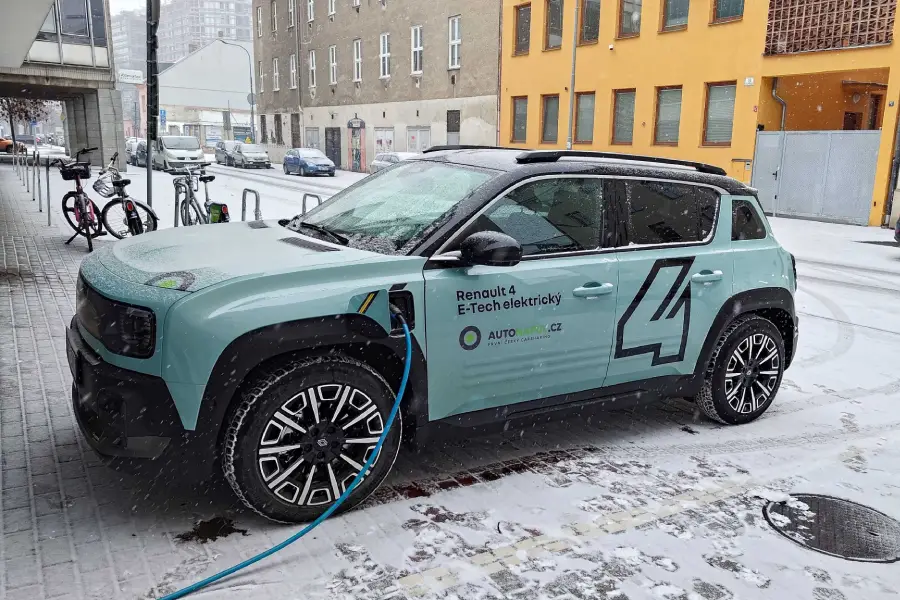
When you arrive at a charging station, park as close as possible with the charging port aligned. Port location varies: sometimes front, sometimes rear sides (like a fuel cap), or on the front fender. Reversing in might be easier depending on the car.
Then you connect the car to the charging station. For DC charging, the cables are always fixed to the station. You just need to plug it into the car. For AC charging, there are two options. Either the station has its own cable, or it only has a socket where you plug in the connecting cable from the car. After connecting the car and the station, you select the desired charging method on the station, perform authorization if needed (using a CCS card, chip, app, via web, etc.), and start charging. You stop charging in the same way.
Conclusion
Electric cars are becoming increasingly popular, widely talked and written about, and it’s good to be prepared for the change they bring.
Carsharing Autonapůl now offers the option to use electric cars in Brno.